A powder coating line is not a booth and a gun — it is a process chain, and the chain is only as strong as its front end. Get the blasting and pre-treatment right and the coating stays on for ten years; get it wrong and the best booth in China will still deliver a finish that fails in the field. We design, supply and commission whole lines: blasting, pre-treatment, drying, spraying, recovery, curing, and the explosion protection that goes with them — sized to your workpiece and your output per hour.
The sequence is fixed even when the equipment is not: loading → shot blasting or chemical pre-treatment → drying → spray booth → curing oven → cooling → unloading. The conveyor that carries workpieces through those stages sets the rhythm of the whole plant, so we design line length and speed from your required output, not from the size of the room you have.
A powder coating line quotation is worthless without these numbers, so collect them before you talk to any supplier:
Send a photo of a typical workpiece next to a tape measure or a person. It saves a week of questions.
We supply the equipment from our partner factory in Changzhou, together with the layout drawing, process parameters for your powder, and commissioning support. We will say plainly which parts we manufacture, which parts are bought in (control components are from named international brands or Chinese equivalents, depending on your preference), and where the boundaries of supply sit — particularly your building, compressed air and electrical connections, which are local scope.
Commissioning is where projects are won or lost. Plan for a trial of your own workpieces, not sample plates, and plan to have your powder supplier in the room. Spray parameters that produce a perfect test panel can fail on a complex welded assembly, and the fix is normally in the blasting and pre-treatment stages rather than in the gun settings.
| Line scope | Shot blasting, pre-treatment, drying, spray booth, recovery, curing oven, conveyor, controls |
|---|---|
| Booth types | Sandwich-arc, flat-panel cyclone, walk-in booth, quick colour-change booth |
| Recovery system | High-efficiency cyclones (carbon / stainless steel), explosion-proof cartridge filters, vacuum closed-loop pumps |
| Powder supply | Quick colour-change and closed-type supply centres with hoppers and pumps |
| Automation | Manual guns, short-stroke and four-dimensional reciprocators, robot booths, workpiece recognition, laser scanning |
| Control | Main control cabinet, PLC-based, with recipe and parameter storage |
| Safety | Spark detection, explosion-proof isolation valves, flameless venting, suppression, IP65 panels |
| Workpiece range | Small fabricated parts up to walk-in booths for large steel structures |
| Conveyor | Overhead conveyor, power-and-free, or floor conveyor depending on weight and process time |
| Utilities | Compressed air and power by customer; oven fuel by customer (gas, diesel or electric) |
The table shows the range we normally supply. Your offer states the exact capacity, span, lifting height, duty class and voltage for your site — and where a figure in this table differs from the offer, the offer prevails. Send us your requirement and we will confirm each line in writing before you order.
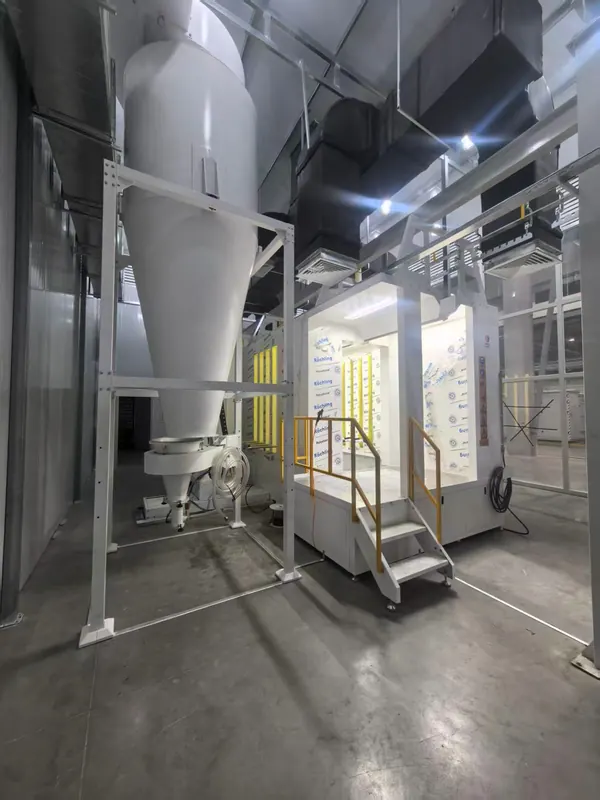
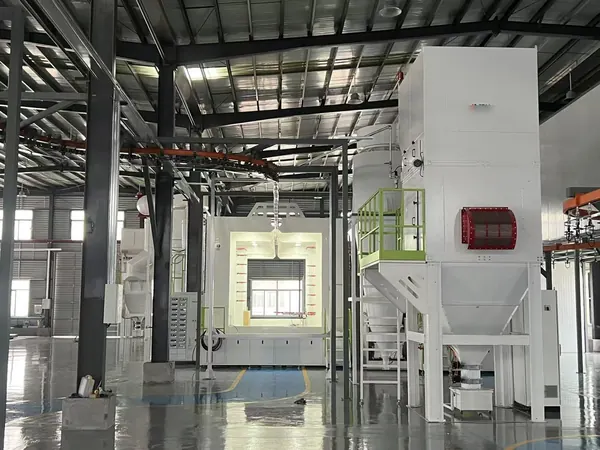
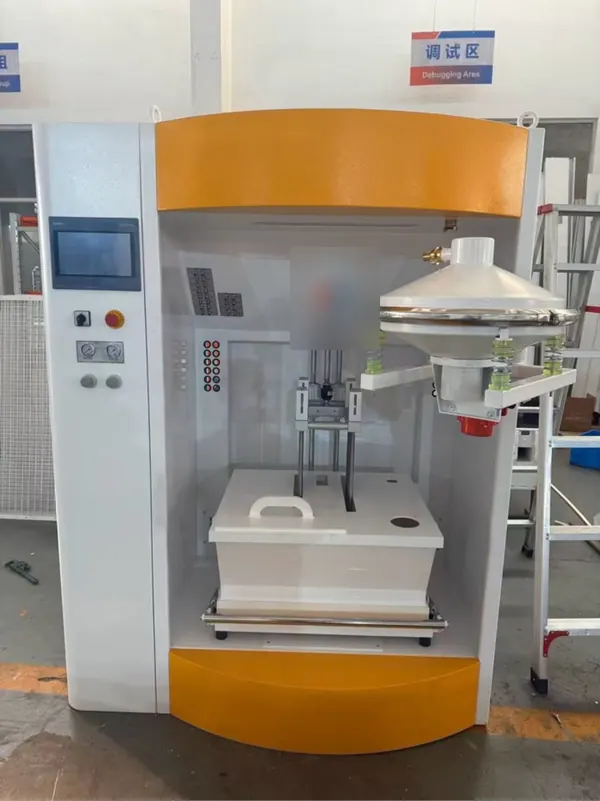
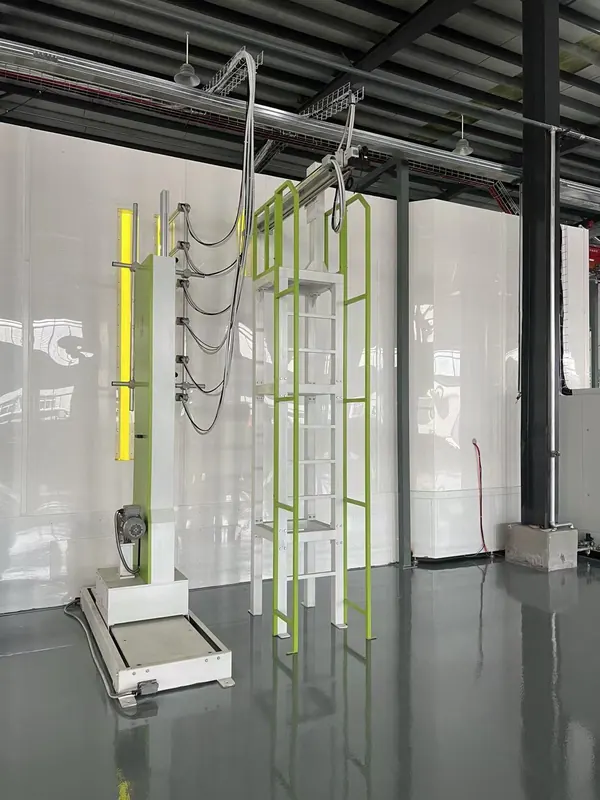
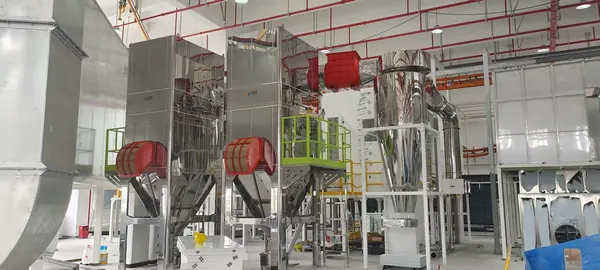
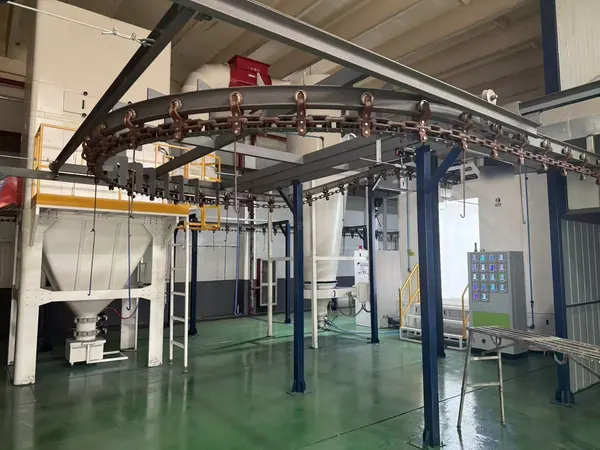
Photographs from our partner factory in Changzhou — the same equipment that would ship on your line.
For fabricated steel that arrives with mill scale, yes — blasting is the stage that produces a surface the coating can key into, and no chemical pre-treatment replaces it. For sheet-metal parts that come clean from the press shop, chemical or conversion-coating pre-treatment alone is usually enough. If a supplier tells you blasting is unnecessary for structural steel, ask what their warranty covers; coating over scale will delaminate in service.
Yes, but the cost sits in cleaning time, not in the booth. Quick colour-change designs — removable hoppers, arc panels and roofs that open, separate powder circuits — cut a change from a few hours to a few tens of minutes. If you change colour more than once a shift, the quick-change design pays for itself; if it is once a month, the standard booth is fine and we will tell you so.
Line length is driven by conveyor speed and process time: drying, spraying and curing each need a fixed number of minutes, so a low-output line for large workpieces can be physically long, while a high-output line for small parts can be surprisingly compact. Send your building plan and workpiece sizes and we will propose a layout that fits the space you actually have, including clearance for loading and unloading.
Powder is a combustible dust and a coating booth is a recognised explosion risk. Serious buyers now specify spark detection, explosion venting or suppression, and isolation between the booth and the recovery system as standard, and many insurance policies require it. We build it in as part of the line rather than offering it as an accessory, and we supply the documentation your safety inspector will ask for.
Workshops, warehouses, assembly and maintenance bays. Light structure, low wheel load, quick to install.
1–20 t · span to 30 mHeavy duty and long spans: steel fabrication, precast yards, smelters, heavy machining shops.
5–100 t · custom spanOutdoor stockyards, precast beds, container and aggregate handling. Hook, grab or C-hook.
3–100 t · rail or tyreSend capacity, span and lifting height and we will reply with a specification and a price within 24 hours.
We quote from 4–5 long-term partner factories in Changyuan, Henan. You will know which one is building your crane, our inspectors test it before shipment, and the drawings, test report and manuals travel with the machine. More about how we work →
Crane type, capacity (t), span (m) and lifting height (m) is usually enough for us to quote. Send a photo of your workshop if you are not sure.